26 Results of the hawk-dove games
This section summarizes class outcomes for Game 1 (same partner) and Game 2 (changing partners). Use it to compare with your own observations and results.
I have crunched the numbers for 2026 and will summarise the results of the hawk-dove game.
In the game, you were asked to compete with the same person 15 times in a row.
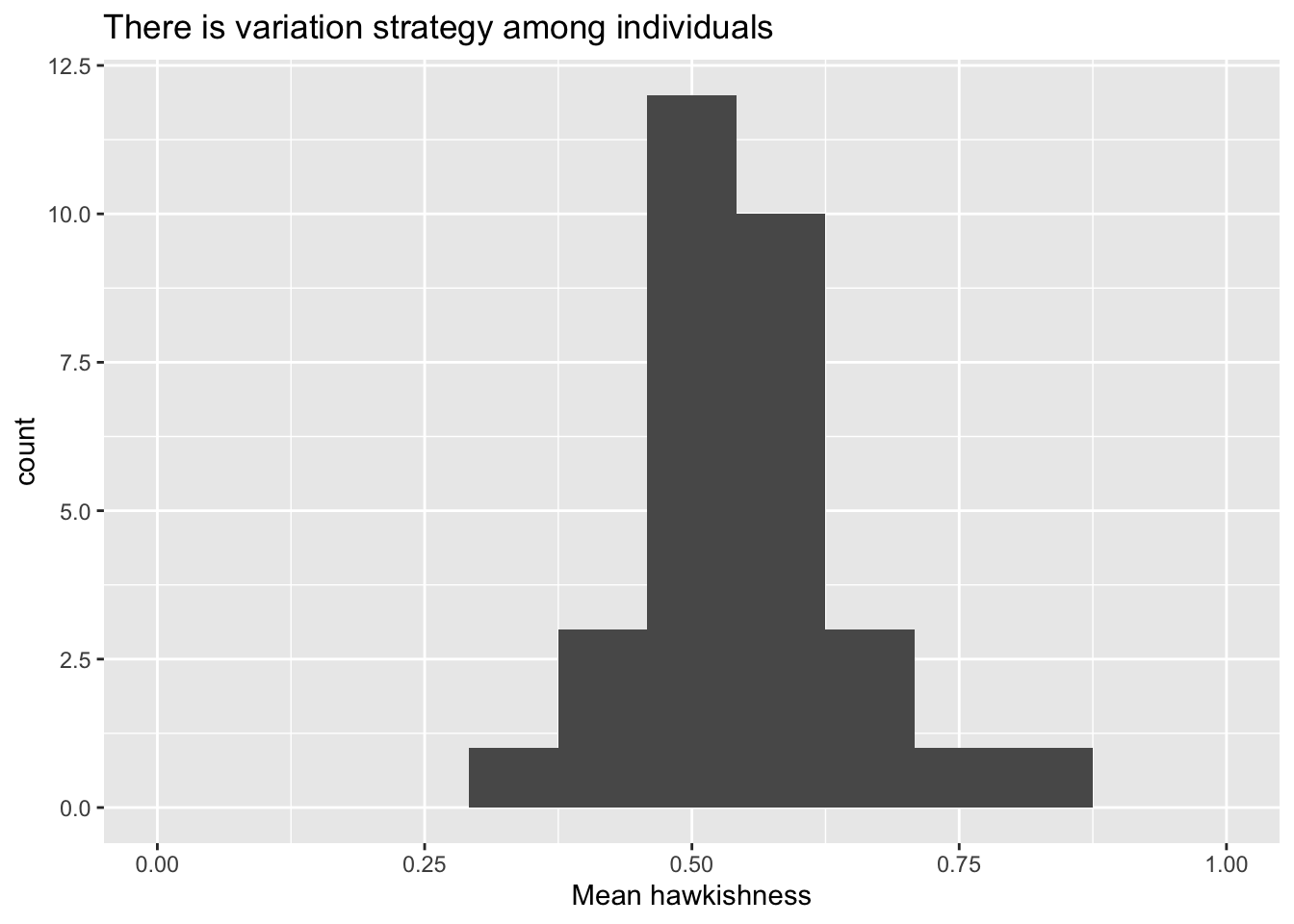
The average hawkishness overall is 0.566, but there is some variation among individuals.
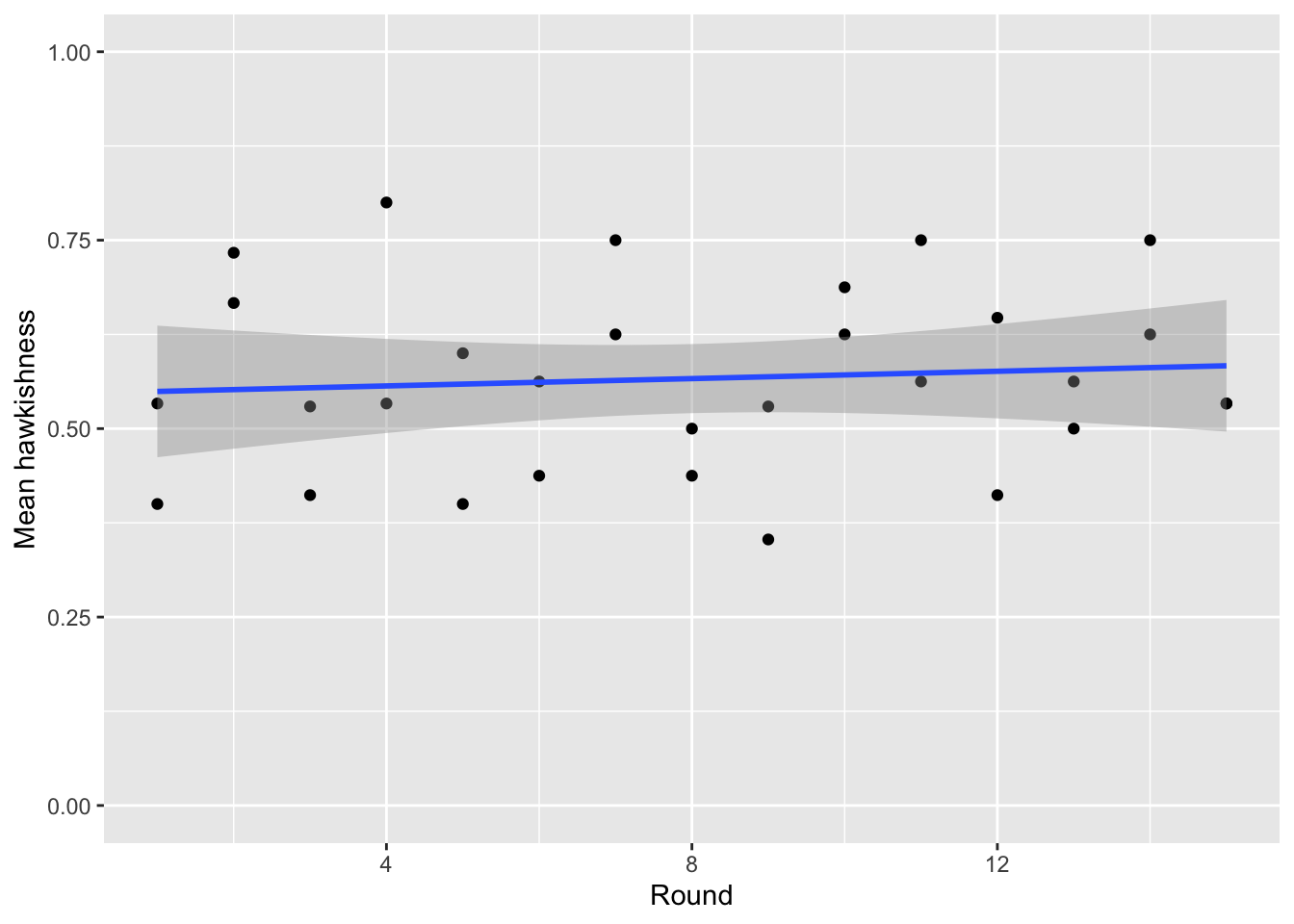
We can now ask whether the level of hawkishness changed during the game on average across all the participants.
We can see from this graph that as the game proceeds round-by-round, there is no significant change in the level of hawkishness (p=0.642).
In other cases, it has been found that the average level of hawkishness tends to decline with the amount of time playing together, as opponents build trust and begin to see the value in cooperation.
 Next, we can ask whether the total benefit received (fitness) is associated with the degree of hawkishness. This, in evolutionary terms, is a way of asking what the Evolutionarily Stable Strategy (ESS) is: is it best to be a hawk, a dove, or something in between?
With the payoffs used in this game (B = 4, C = 3), a single, anonymous encounter has a simple answer. Because B > C, Hawk beats Dove regardless of what your opponent plays (Hawk-vs-Dove gives 4 > 2 for Dove-vs-Dove, and Hawk-vs-Hawk gives 0.5 > 0 for Dove-vs-Hawk), so the one-shot ESS here is pure Hawk, not an intermediate mix. (The familiar “stable mix of hawks and doves” result only arises when the cost of fighting, C, exceeds the value of the resource, B — the opposite of the situation here. With B > C, the payoff ranking Hawk-vs-Dove > Dove-vs-Dove > Hawk-vs-Hawk > Dove-vs-Hawk is in fact the same structure as the classic Prisoner’s Dilemma, with Hawk playing the role of “Defect”.)
But Game 1 was not a single anonymous encounter — you played the same partner 15 times in a row. That changes the incentives: playing Hawk risks provoking Hawk-Hawk retaliation for the rest of the 15 rounds, which pays only 0.5 each round, far worse than the 2 each you would get by settling into mutual Dove-Dove play. This is the classic argument for reciprocity in repeated games (Axelrod & Hamilton’s “evolution of cooperation”): when you meet the same partner repeatedly, cooperation can pay off even though defection (Hawk) would win a single, one-off encounter.
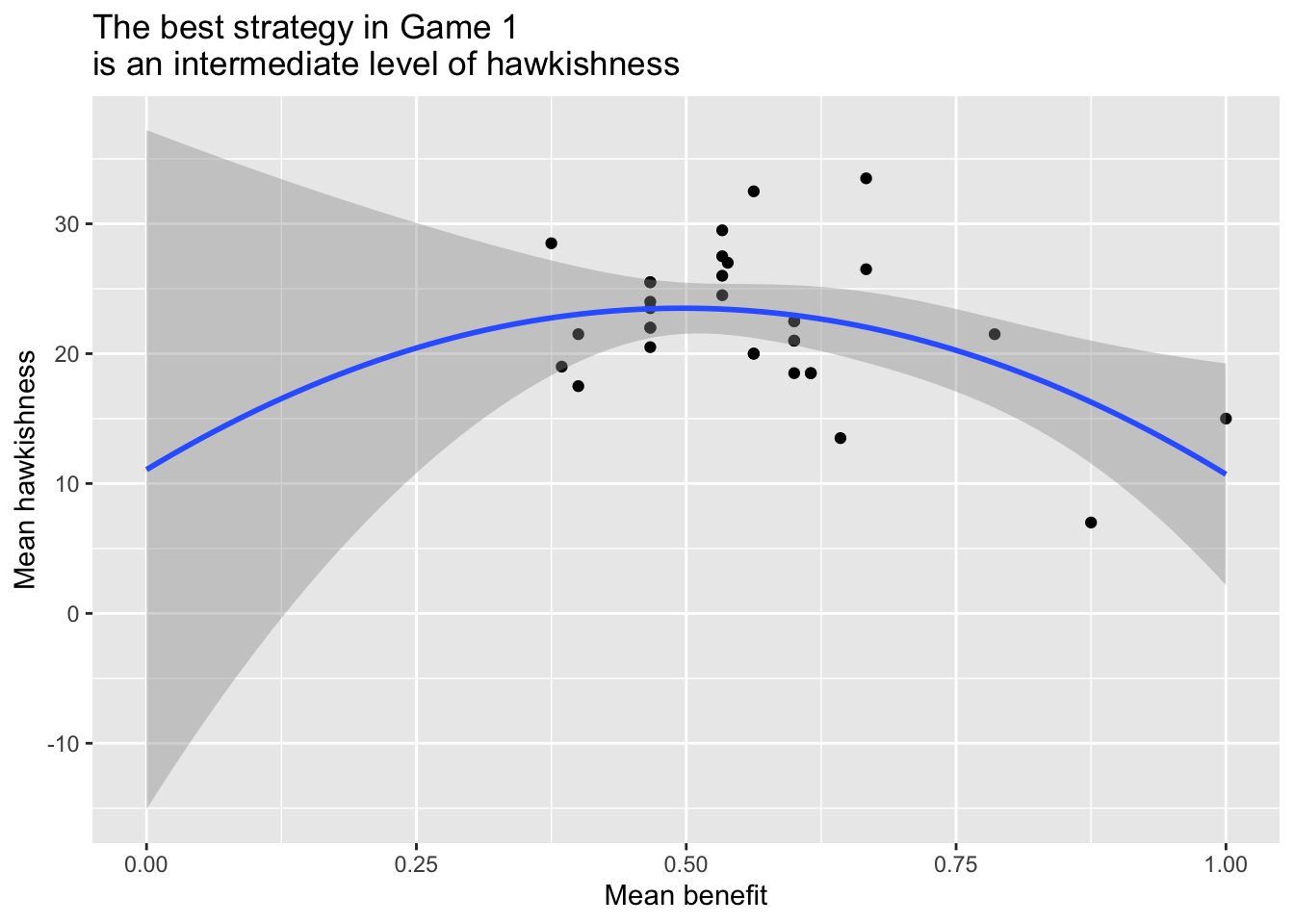
That is indeed closer to what we see: hawkishness and total benefit are negatively related here — the more hawkish you were with your (fixed) partner, the less you earned overall, rather than there being an intermediate optimum. That is consistent with the reciprocity/retaliation argument above, not with the simple one-shot ESS calculation.
26.0.1 Game 2 - different opponents
We didn’t do this one in class this year, so here is what we found last year.
The students were asked to compete against a new opponent every round. The idea was that this would make it much harder to learn your opponents strategy and may be harder to come to an agreement that reduces aggression.
Firstly I have calculated the average hawkishness as 0.681, which is not so different from the previous game.
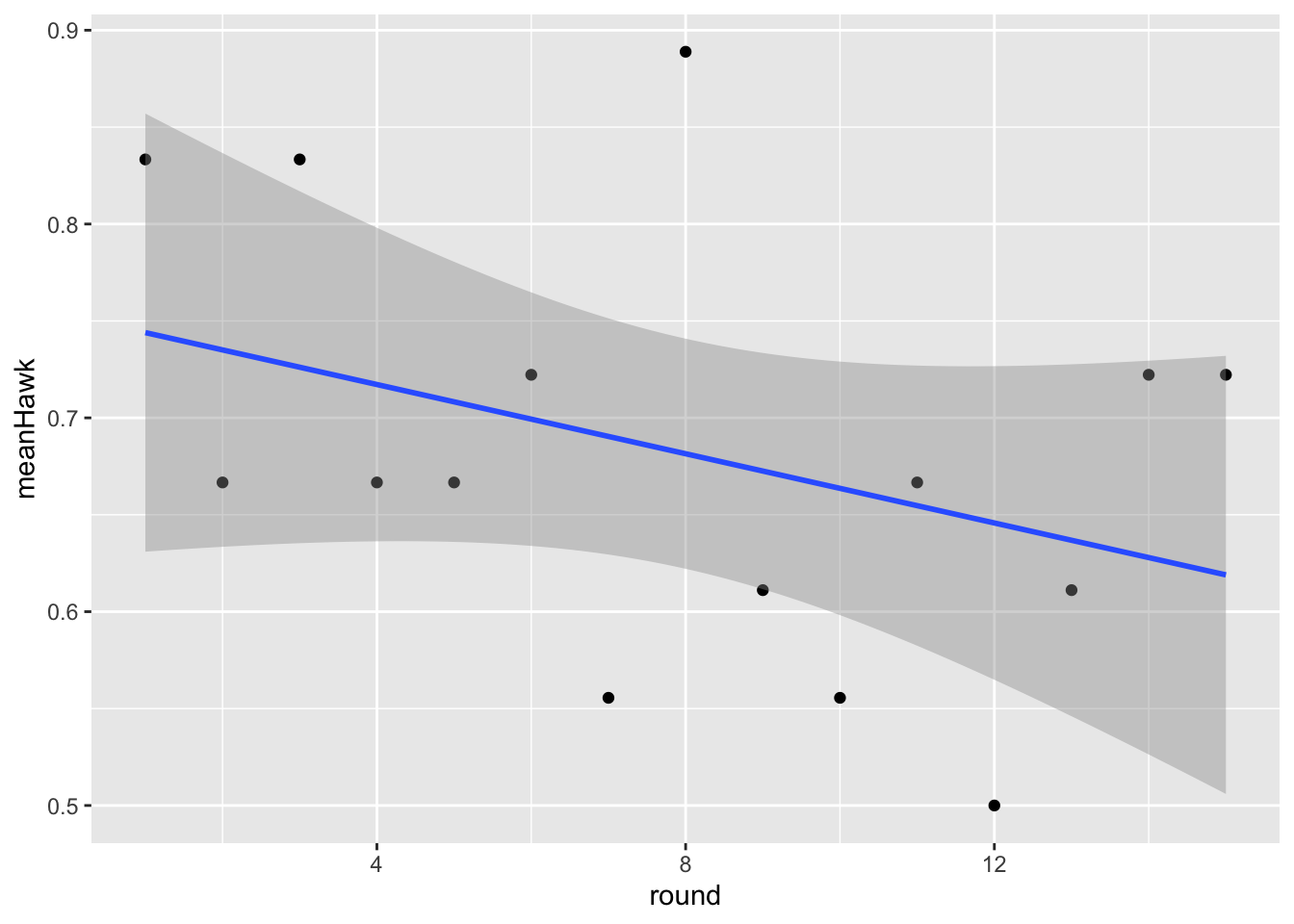
Again, we can ask whether hawkishness changed during the game.
In this case, it DOES look like hawkishness declines more during the game. However, this trend is not significantly different from horizontal (p = 0.184).
Finally we can look at what the best strategy is in Game 2.
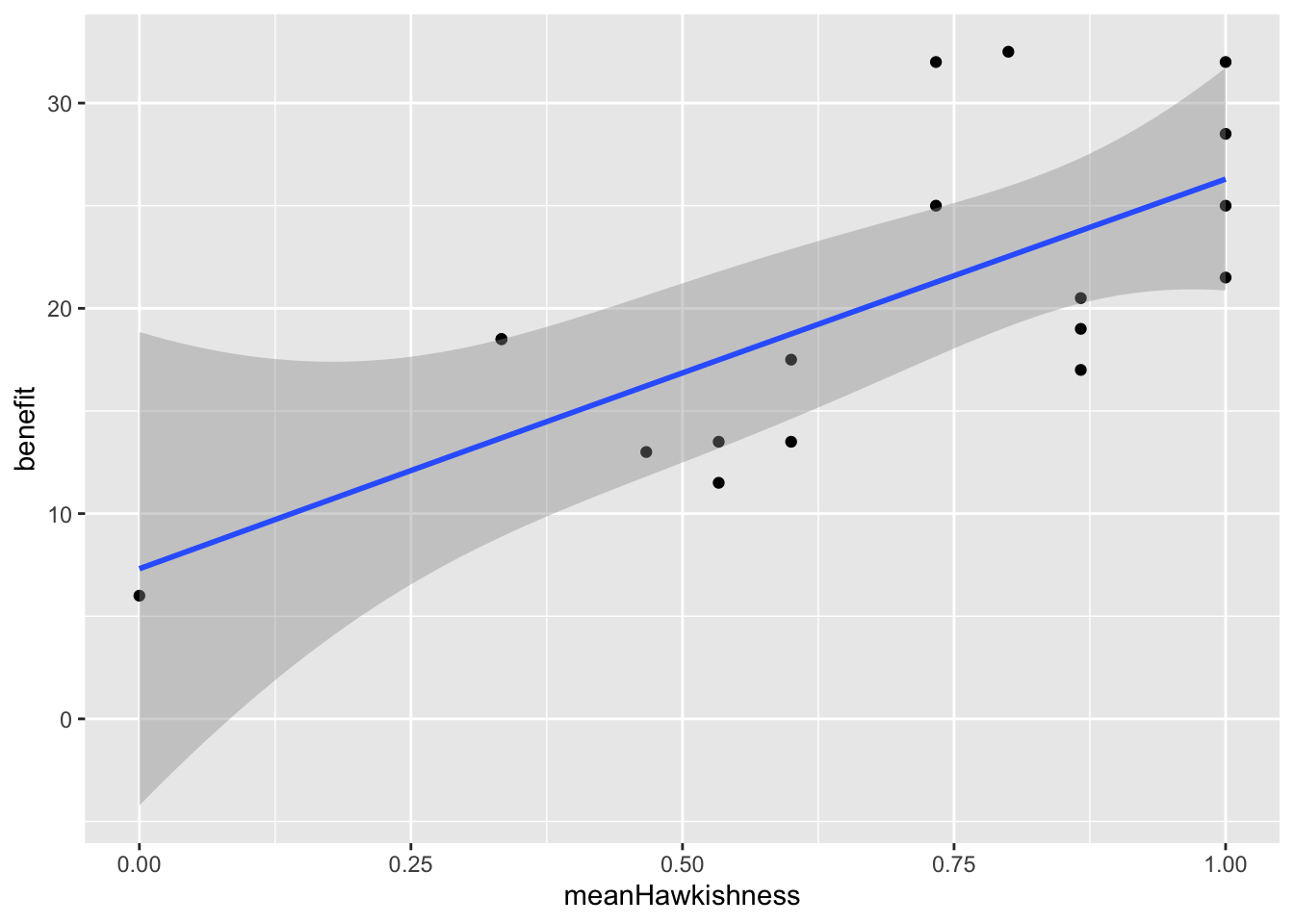
It looks like the best strategy has changed a lot! Now the best strategy is to be a hawk.
This matches the one-shot theoretical prediction from earlier much better than Game 1 did. In Game 2 you faced a new partner every round, so there was no opportunity to build reciprocity, and no way to be “punished” for playing Hawk against the same individual again. With no repeated interaction — no “shadow of the future” — the game reduces to the simple one-shot logic, and since B > C, Hawk pays off best.
In this setting we might expect natural selection to drive towards the evolution of more aggressive individuals.
Put together, the two games illustrate a general result from game theory: repeated interaction with the same partner can favour cooperation even in a game where defection (Hawk) wins any single encounter, while anonymous, one-off interactions favour the individually dominant strategy. This is one reason why reputation, memory, and repeated encounters matter so much for the evolution of cooperation, both in nature and in human societies.
Think about what this means in terms of human cooperation and conflict avoidance.
Can you see the value of understanding your opponent/competitor?