BB512 - Population Biology and Evolution
2026-10-18
1 Welcome to BB512
Welcome to the Population and Evolution course. The course, and this website, is divided into five parts:
- Evolution by Natural Selection
- Population Growth Models
- Population Genetics and Evolution
- Interactions Between Species and Community Structure
- Animal Behaviour, Altruism and Sexual Selection
The recommended textbook is Neal (2018). Other useful textbooks, that are NOT mandatory, but could be useful are Gotelli (2008) and Stearns & Hoekstra (2005).
- Neal, D. (2018). Introduction to Population Biology (2nd edition). Cambridge: Cambridge University Press. doi:10.1017/9781139107976
- Gotelli, NJ (2008) A Primer of Ecology. Fourth Edition, Sinauer Associates. ISBN: 978-0878933181
- Stearns, SC & Hoekstra, RF (2005) Evolution: An Introduction. 2nd Edition, Oxford University Press. ISBN: 978-0199255634
In addition to this, I will provide a reading list of journal articles that are relevant to the material. These are optional, but highly recommended because they give extra context and background to the course and show you how the theory is used in recent research.
1.1 How to use this book
Each chapter follows a consistent template so you can move quickly between concepts and tasks.
- Learning outcomes: what you should be able to do by the end.
- Background: the core concepts and equations.
- Worked example: a short walk-through that shows the method.
- Your task: the practical exercise or analysis.
- Takeaways: a short summary of the main ideas.
If you are short on time, read the Learning outcomes and Takeaways first, then do the Your task section. Use the worked example only if you need a refresher.
1.2 Parts overview
The table below shows how each part maps onto the major skills you will build through the course.
| Part | Focus | Skills you build |
|---|---|---|
| 1. Evolution by Natural Selection | Selection, adaptation, variation | Explain selection in natural contexts; identify selective pressures and outcomes |
| 2. Population Growth Models | Exponential and logistic growth, stochasticity | Build and interpret population growth models; reason about parameter effects |
| 3. Population Genetics and Evolution | Allele frequencies, drift, heritability | Analyze genetic change over time; estimate heritability from data |
| 4. Interactions Between Species and Community Structure | Competition and predator-prey models | Evaluate stability and dynamics of interacting species |
| 5. Animal Behaviour, Altruism and Sexual Selection | Game theory and behavior | Interpret behavior through evolutionary payoffs and strategies |
| 6. Solutions/answers | Answer keys and model results | Check work and compare interpretations |
| 7. Appendix - extras | Extensions and advanced examples | Apply methods to additional contexts |
1.3 This website and other course materials
This website holds most of the materials you need for the practical exercises you will do during the course. You will also find the Schedule here (on the web-version only).
We may not do ALL of these exercises, but you are welcome to do ones we miss in your own time.
You will find other materials via itsLearning.
For most classes you will need your personal laptops: Please bring them to class (and remember a power supply!).
1.4 Expectations
There are lectures and practical exercise sessions on the course. The practical sessions are designed to help you understand the subject better and I expect students to attend and actively participate in both. There will also be some multiple-choice quizzes (e-tests) during the semester. These are intended to help you figure out whether you know the material, and whether there are areas you need to revisit. They do not contribute to your final grade, but I hope you will attempt them. They will definitely increase your understanding of the material. Note that the final assessment will be a similar format!
I expect students to make every effort to keep up with the core reading (mainly the textbook chapters), and to ask questions where they don’t understand.
1.5 Assessment
The assessment for the course will be an electronic exam held in January with multiple-choice and short answer questions. It is worth noting that exam format will be similar to the quizzes mentioned above. The date for the exam will be finalised in December.
1.6 Instructors
The instructors of the course are:
- Owen Jones, Associate Professor, jones@biology.sdu.dk
- Thomas Bjørneboe Berg, Associate Prof./Senior Scientist at Naturama, thomas@naturama.dk NULL
If you have any problems accessing materials, or have any questions regarding the course feel free to send me (Owen) an email, or make a comment in the form I mentioned above. You can also make an appointment to see me via Zoom or in my office if necessary*. PLEASE REMEMBER to tell me which course you are referring to if you send an email!
Owen Jones, course coordinator - jones@biology.sdu.dk
Office location: V12-410b-2
1.7 Software
We will use Excel and R/RStudio during this course.
1.7.1 Excel
I expect you will already have Excel installed, so there is not much to say here.
Be aware that Excel differs depending on the language it is localised in. For example, Danish vs. English. This means that some of the commands might differ between versions. See here for examples.
1.7.2 R and RStudio
R and RStudio are two separate pieces of software. RStudio is a user-friendly interface to talk to R, it cannot work if you have not got R installed. So, when you install these two programs, install R first, then RStudio.
Already have them installed? I strongly recommend updating to the latest versions of R and RStudio, which you can download at the following sites:
If you are unsure whether you should update your R or RStudio try the following code. If it produces a nice graph, then your R is sufficiently up-to-date. If there are error messages, then you probably need to update R.
install.packages("popdemo")
library(popdemo)

A <- matrix(c(0,1,2,0.5,0.1,0,0,0.6,0.6), byrow=TRUE, ncol=3)

pr <- project(A, vector="n", time=10)
plot(pr)
This book includes equations.
Equations sometimes do not render correctly on some web browsers.
From experience, Chrome tends to be the most reliable, Safari (Mac only) also works well.
Can you see the following equation?
\(N_{t+1}=N_{t}+r_{m} N_{t}\left(1-\frac{N_{t}}{K}\right)\)
It should look like this:
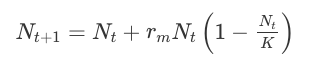
If it doesn’t look right, then you should try another browser (maybe even your phone browser) or investigate a solution.
1.8 Schedule
This is the schedule for the course. You can check itsLearning for the dates, times and locations. Also check itsLearning for details of other tasks/assignments/reading etc.
Part | Session | Type | Topic | Instructor |
|---|---|---|---|---|
Evolution by Natural Selection | 1 | Lecture | Darwin and his theories (what is evolution) | ORJ |
2 | Practical | Exercise - The Blind Watchmaker | ORJ | |
3 | Lecture | Understanding Natural Selection | ORJ | |
4 | Practical | Exercise - Bug hunt camouflage (NetLogo) | ORJ | |
Population Growth Models | 5 | Lecture | Exponential growth | TBB |
6 | Practical | Exercises - Geometric growth (in class); Stochastic growth (as homework) | ORJ | |
7 | Lecture | Logistic growth | TBB | |
8 | Practical | Exercises - Basic logistic population growth (in class); Deeper into logistic growth (as homework) | ORJ | |
9 | Lecture | Life tables | ORJ | |
10 | Practical | Exercises - Life tables and survivorship types | ORJ | |
11 | Lecture | Age and Stage Structured Models | ORJ | |
12 | Practical | Exercises - Matrix population modeling | ORJ | |
13 | Lecture | Evolution of Life Histories | ORJ | |
14 | Practical | Exercises - How many eggs should a bird lay?; Trade-offs and the force of selection | ORJ | |
Population Genetics and Evolution | 15 | Lecture | The Hardy-Weinberg Principle | ORJ |
16 | Practical | Exercises - Hardy-Weinberg equilibrium | ORJ | |
17 | Lecture | Mutation and Genetic Variance of Populations | ORJ | |
18 | Practical | Exercises - The gene pool model | ORJ | |
19 | Lecture | Genetic Drift and Effective Population Size | ORJ | |
20 | Practical | Practice Exam 1 (covering material until now) | ORJ | |
21 | Lecture | Inbreeding | ORJ | |
22 | Practical | Feedback on practice exam 1 | ORJ | |
23 | Lecture | Migration, Gene Flow and Differentiation of Populations | ORJ | |
24 | Practical | Exercises - Neutral/adaptive in humans | ORJ | |
25 | Lecture | Haploid and Zygotic Selection | ORJ | |
26 | Practical | Practice written answer exam | ORJ | |
27 | Lecture | Polygenic Inheritance and Quantitative Genetics | ORJ | |
28 | Practical | Exercises - Heritability from regression | ORJ | |
Interactions Between Species and Community Structure | 29 | Lecture | Competition 1 (Interspecific Competition) | TBB |
30 | Practical | Exercises on Lotka-Volterra competition | ORJ | |
31 | Lecture | Competition 2 (Interspecific Competition) | TBB | |
32 | Practical | Exercises on Lotka-Volterra competition (continued) | ORJ | |
33 | Lecture | Predation 1 | TBB | |
34 | Practical | Exercises on Lotka-Volterra predator-prey dynamics (part 1) | ORJ | |
35 | Lecture | Predation 2 | TBB | |
36 | Practical | Exercises on Lotka-Volterra predator-prey dynamics (part 2) | ORJ | |
37 | Lecture | Interactions and community structure | TBB | |
38 | Lecture | Interactions and community structure | TBB | |
39 | Lecture | Coevolution | ORJ | |
40 | Practical | Practice Exam 2 (covering material until now). | ORJ | |
Animal behaviour, altruism and sexual selection | 41 | Lecture | Animal Behaviour, Altruism and Limiting Aggression | ORJ |
42 | Practical | Exercises - Hawks and Doves | ORJ | |
43 | Lecture | Sexual Selection and Mating Systems | ORJ | |
44 | Practical | Feedback on practice exam 2 | ORJ | |
45 | Lecture | |||
46 | Practical |